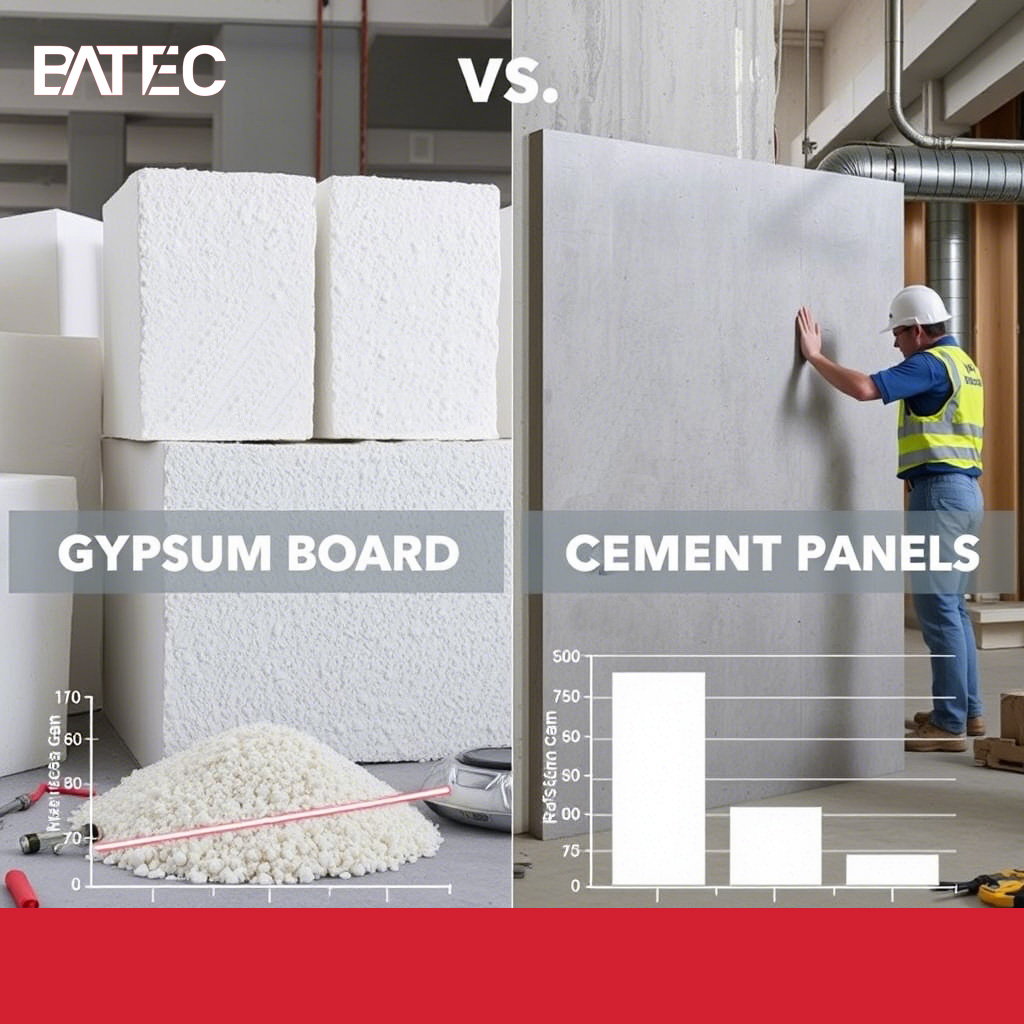
When selecting materials for internal wall and ceiling finishes, builders often compare gypsum-based products with cementitious alternatives such as sand-cement plasters and screeds. Each material has distinct advantages and limitations, and the choice depends on factors like cost, performance requirements, application speed, and environmental considerations.
Gypsum-based materials generally offer faster application and drying times, reducing project duration. They provide a smoother finish out-of-the-box, requiring minimal sanding before painting. In contrast, cementitious materials are harder and more abrasion-resistant, making them suitable for external or high-traffic areas. However, they tend to crack more easily due to shrinkage and require additional finishing coats.
Thermally, gypsum performs better than cement, offering greater insulation and contributing to energy savings. Acoustically, gypsum also absorbs sound more effectively, making it preferable in noise-sensitive environments. On the other hand, cementitious materials exhibit higher compressive strength and moisture resistance, though they are heavier and may place additional load on building structures.
From an environmental perspective, gypsum has a lower embodied energy and is more readily recyclable. Cement, being a major contributor to global CO₂ emissions, is under increasing scrutiny. However, advancements in eco-friendly cement blends and hybrid gypsum-cement composites are emerging as compromise solutions that balance performance and sustainability.
Feature | Gypsum-Based Materials | Cementitious Materials |
Chemical Composition | Calcium Sulfate Hemihydrate (CaSO₄ · ½ H₂O) | Cement (clinker + additives), Sand, Water |
Setting Mechanism | Rehydration (chemical reaction with water) | Hydration (chemical reaction with water) |
Setting Time | Very fast (minutes to hours) | Slower (hours to days) |
Drying Time | Rapid; less reliant on air drying after set | Slower; requires prolonged curing/drying |
Finish Quality | Naturally smooth, fine finish; minimal sanding | Rougher often requires skim coat/putty for a smooth finish |
Workability | Very good; easy to spread/trowel; machine-apply readily | Good, but stiffer; often requires more effort to achieve a smooth finish |
Shrinkage & Cracking | Low drying shrinkage: less prone to cracks. | Prone to drying shrinkage cracks if not properly mixed/cured; also from thermal stress/movement |
Hardness/Abrasion | Softer, less abrasion-resistant | Harder, highly abrasion-resistant |
Moisture Resistance | Low (standard); moisture-resistant variants available, but not for direct water exposure | High; suitable for wet environments and direct water contact |
Fire Resistance | Excellent (releases chemically bound water vapor, cooling structure) | Good (non-combustible) |
Thermal Insulation | Good insulator (lower thermal conductivity) | Moderate insulator (higher thermal conductivity) |
Acoustic Performance | Good sound absorption/insulation | Moderate sound insulation |
Weight | Lighter (especially lightweight boards) | Heavier |
Embodied Energy | Generally lower | Higher (cement production is energy-intensive) |
CO₂ Emissions | Lower from manufacturing | Higher (significant CO₂ from clinker production) |
Recyclability | Highly recyclable (can be re-calcined or reused in agriculture) | Limited recycling for mixed demolition waste; some concrete recycling is possible |
pH Level | Neutral (7–8) | Alkaline (12–13) |
Curing Required | No extended wet curing | Requires wet curing to prevent cracking and ensure strength |
Cost | Generally comparable or slightly higher for specialized gypsum boards | Varies widely, but basic sand-cement plaster can be cheaper initially |